
Flooring terms, explained.
Twelve words that decide what you buy, what it costs to keep, and whether the warranty answers the phone. Each one gets a definition and the question to ask back.
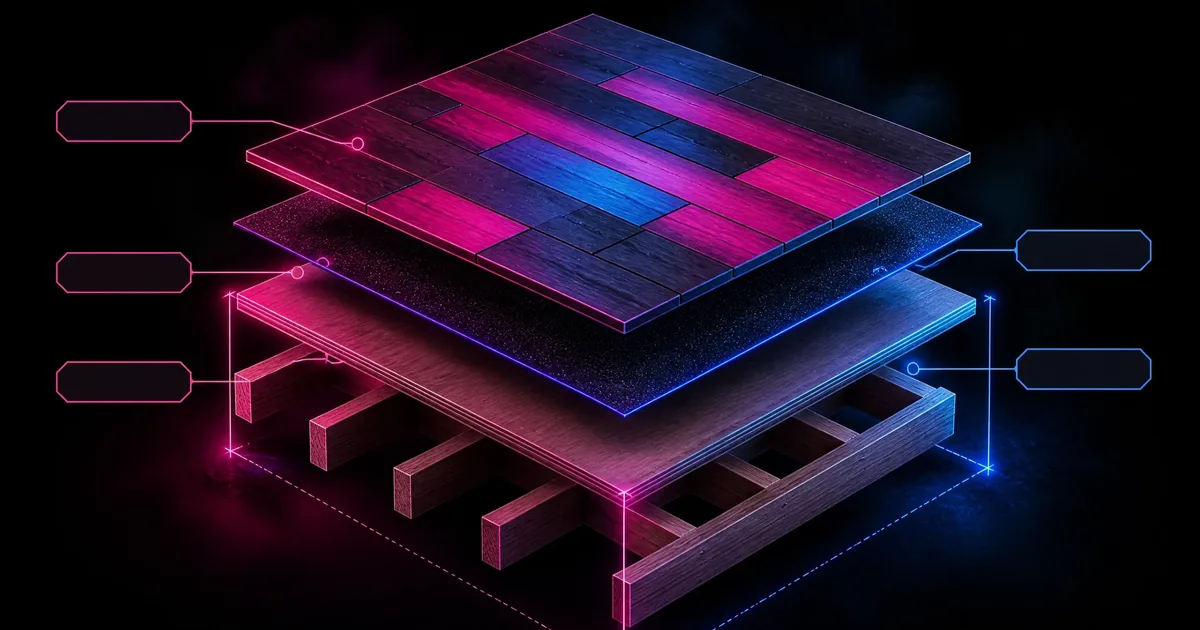
The spec sheet is not hiding anything. It is just written for installers.
A flooring quote is a dense little document, and almost every number on it means something different from what a shopper assumes. The millimeter figure is the whole board. The mil figure is the clear top layer. The AC rating belongs to laminate, not vinyl. The "waterproof" line refers to the core, not the room. None of that is a trick; it is just shorthand that never got translated for the person paying for it.
The twelve terms below are the ones that change a decision. Wear layer and mils tell you how long a vinyl floor will look new. AC rating does the same job for laminate, on a different scale. SPC and WPC decide how the floor feels and where it can go. Subfloor, underlayment, acclimation and expansion gap decide whether the installation succeeds, which is a different question from whether the product is any good.
Use this page in the store. Open the term, read the two paragraphs, and ask the question at the end. If the answer is vague, that is information too. The material matchup puts the terms to work on four real comparisons, and the myth wall covers the claims that get repeated instead of explained.
Open a term. Ask the question.
The order is roughly the order you meet them: first the box, then the install, then the building.
Wear layer The clear top coat on a vinyl plank that takes the abuse so the printed floor underneath does not have to.
The wear layer is the transparent top layer of a vinyl plank, sitting above the printed decor film. It is what your shoes, dog claws, chair casters, and dropped keys actually touch. On vinyl it is measured in mils, and the spec sheet should list it as a number, not a feeling.
A thicker wear layer resists abrasion and wear-through for longer. It does not make the plank waterproof, and it does not stop a heavy point load from denting the core. Laminate uses a different scale, the AC rating, for its own wear surface.
Ask this: “What is the wear layer in mils, and what traffic class does the manufacturer rate it for?” Get it in writing on the quote.
Also called: wearlayer, protective layer
AC rating The 1-to-5 abrasion scale used for laminate flooring, not for vinyl.
AC stands for abrasion class. Laminate floors are tested and sorted from AC1 to AC5, with higher numbers rated for heavier traffic: AC1 is light residential, AC3 is the common residential workhorse, AC4 and AC5 move into commercial territory. The rating comes from a standardized abrasion test, not from the thickness of the board.
It tells you about surface wear. It does not tell you how the floor handles water, how it sounds, or whether the joint will hold up. A high AC rating on a poorly made core is still a poorly made core.
Ask this: “Which AC class is this laminate rated for, and does the warranty match that class?” Vinyl does not use AC ratings, no matter what the sales tag says.
Also called: AC1, AC3, abrasion class
Related: wear layer , mils , laminate
Mils Thousandths of an inch, the unit used to measure a vinyl wear layer.
One mil is one thousandth of an inch, or 0.0254 millimeters. It is a tiny unit, which is why it is useful for measuring something as thin as a wear layer. A 20 mil wear layer is 0.02 inch of clear vinyl between your boots and the printed pattern.
Do not confuse mils with millimeters. Plank thickness is usually given in millimeters; wear layer thickness is usually given in mils. A 6 mm plank and a 6 mil wear layer are describing two different measurements, and sales copy mixes them up constantly.
Ask this: “Is that number mils or millimeters?” Then check whether the number refers to the wear layer or the whole board.
Also called: mil, thou
Related: wear layer , spc , ac rating
Click-lock A machined tongue-and-groove edge that lets planks snap together without glue.
A click-lock floor has a shaped profile on each edge. The planks angle or drop into each other and lock in place, so the floor holds itself together without adhesive. It is the standard system for floating laminate, rigid-core vinyl, and many engineered floors.
The joint is the weakest point in a water-resistant floor. Some systems are treated or gasketed to resist spills; most are not designed for standing water. A damaged tongue or groove usually means replacing the plank, not repairing it.
Ask this: “Is the locking joint rated for the moisture I expect in this room, and does the warranty require a specific underlayment under it?”
Also called: click system, drop-lock, angle-angle
Related: floating floor , expansion gap , laminate
Floating floor A floor that rests on the subfloor instead of being nailed or glued to it.
A floating floor is not attached to the subfloor. The planks or tiles are locked or taped together into one big sheet that sits on top of an underlayment, held down by gravity and trim. Laminate, rigid-core vinyl, and some engineered wood floors are installed this way.
Because the whole floor moves as one piece, it needs room to expand at the walls, at doorways, and often at large spans. Skip those gaps and the floor will tent, gap, or creak. A floating floor also needs a flat, sound subfloor; it will follow every dip.
Ask this: “Where are the expansion breaks, and what underlayment does the manufacturer require for a floating install?”
Also called: float, floating installation
Related: click lock , underlayment , expansion gap
Subfloor The structural surface under your flooring: plywood, OSB, or a concrete slab.
The subfloor is the part of the building the finish floor sits on. In most houses it is plywood or OSB over joists; in basements and slab-on-grade homes it is concrete. It carries the load, and it decides whether the floor above it stays flat and quiet.
Three things matter before anything is installed: it must be dry, it must be flat within the manufacturer’s tolerance, and it must be structurally sound. A bouncy joist system will crack tile and pop laminate joints no matter how good the flooring is. Moisture moving through a slab will find a wood floor eventually.
Ask this: “What are the flatness and moisture readings, and where are they written down?” If nobody measured, nobody knows.
Also called: deck, substrate
Related: underlayment , expansion gap , acclimation
Underlayment The layer between the flooring and the subfloor that adds cushion, sound control, or a moisture barrier.
Underlayment is not the subfloor and not the flooring. It is the sandwich filling: a foam, cork, rubber, or composite sheet that goes down before a floating floor to soften the walk, quiet the hollow sound, and sometimes block moisture vapor from a concrete slab.
It is not a leveling compound. It will not fix a hump, a dip, or a squeak. Stacking two pads or adding a pad under a floor that already has one attached can stress the click joints and void a warranty.
Ask this: “Which underlayment does the flooring manufacturer approve, and does it need a separate vapor barrier?” The answer should come from the flooring spec, not the aisle endcap.
Also called: underlay, pad, vapor barrier
Related: subfloor , floating floor , acclimation
Acclimation Letting flooring sit in the room where it will be installed so it reaches that room's temperature and moisture level.
Acclimation is the waiting period. Sealed boxes of flooring are moved into the room, stacked flat, and left there long enough for the material to settle into the same temperature and humidity as the space. The HVAC should be running at normal living conditions while it happens.
Solid hardwood is the strict case: it needs the wood and the subfloor to reach a workable moisture balance, and the manufacturer’s instructions decide the timing. Engineered wood, laminate, and vinyl often ask for a shorter period, and some rigid-core products say none at all. A garage is not a room.
Ask this: “How many days does this exact product require, and what moisture readings do you need before installation?” Write the date on the box.
Also called: acclimate, conditioning
Related: expansion gap , subfloor , engineered
Expansion gap The small gap left between a floating floor and the wall so the floor can move without buckling.
Wood and vinyl both move with temperature and humidity. A floating floor moves as one sheet, so it needs a gap at every fixed object: walls, door frames, pipes, cabinets, and thresholds. The gap is hidden later by baseboard or shoe molding, which is why you never see it.
Fill that gap with grout, caulk, or thinset and you have removed the room the floor needed. The result shows up later as tenting in the middle of a room or a joint that pops open at a doorway.
Ask this: “What gap does the manufacturer specify, and who is checking it before the trim goes on?” A common starting point is a quarter inch, but the spec sheet wins.
Also called: perimeter gap, expansion space
Related: floating floor , click lock , acclimation
SPC Stone polymer composite: a dense, rigid vinyl core made with limestone dust.
SPC stands for stone polymer composite. The core is PVC mixed with a high proportion of limestone, which makes it dense, hard, and dimensionally stable. It is the “rigid core” behind most waterproof click floors sold today.
SPC is waterproof in the core, holds up to temperature swings better than soft vinyl, and feels firm underfoot. That firmness is also the downside: it is less forgiving on an uneven subfloor and can feel cold and hard. The wear layer, not the core, decides how it handles abrasion.
Ask this: “What is the wear layer in mils, and what flatness tolerance does this SPC need?” Rigid does not mean self-leveling.
Also called: rigid core, stone core
Related: wpc , wear layer , click lock
WPC Wood plastic composite: a foamed vinyl core that is softer and warmer underfoot than SPC.
WPC stands for wood plastic composite, though there is no meaningful wood content doing structural work. The core is foamed PVC, which makes the plank lighter, thicker, and more cushioned than an SPC core. It is still a vinyl floor, and the core is still waterproof.
The foam gives WPC a warmer, quieter feel and a little more tolerance for minor subfloor variation. It is also softer, so heavy furniture legs and concentrated loads can leave dents. WPC planks are often thicker overall, which matters for door clearance and transitions.
Ask this: “Is the core SPC or WPC, and what does that do to my door heights?” Then compare wear layers like an adult, because the core is not the whole story.
Also called: wood core, foam core
Related: spc , wear layer , underlayment
Engineered Real wood veneer glued to a plywood or fiberboard core, sold as a more stable alternative to solid wood.
Engineered hardwood is a real wood floor, just not a single piece of wood. A thin slice of the species you want is bonded to a core of crossed plywood layers or fiberboard. The crossed core resists the seasonal swelling and cupping that solid wood fights, which is why engineered floors work in more rooms and over more subfloors.
The top veneer is the part you can sand. A thick veneer may take a refinish or two; a thin one may not be sandable at all. The word “engineered” says nothing about that thickness, the finish, or the quality of the core.
Ask this: “How thick is the wear layer of actual wood, and can this floor be sanded and refinished?” That answer separates a lifetime floor from a decade floor.
Also called: engineered hardwood, engineered wood
Related: acclimation , subfloor , underlayment
Definitions are cheap. Decisions are the point.
Four matchups, side by side
SPC vs WPC, laminate vs vinyl, engineered vs solid, tile vs LVP. Drag the divider, read the table.
Thicker is not better
The millimeter number and the mil number measure different things. One of them decides how the floor wears.
What a wear layer is and why mils matter
The long version of term one, including what a wear layer does not protect you from.