
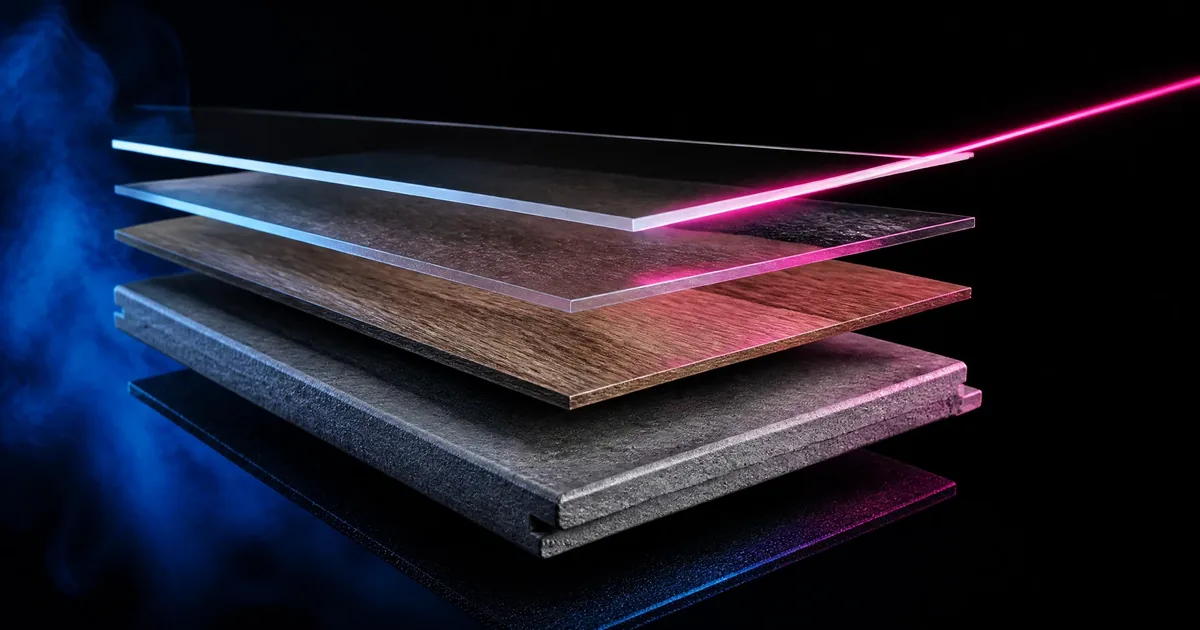
The wear layer is the clear coat on top of a vinyl plank, meaning LVT, SPC, and WPC, the thin sacrificial surface that takes the scratches so the printed floor underneath does not have to. It is measured in mils, and the number is one of the few specs on the box that actually predicts how the floor will age.
Mils, not millimeters, and definitely not thickness
A mil is one thousandth of an inch. Not a millimeter, not a micron, not a marketing unit. One mil is 0.001 inch, which is about 0.025 millimeters, which is thin enough that you will never measure it with the tape in your kitchen drawer.
Vinyl wear layers are quoted in mils. Almost everything else in flooring is quoted in millimeters or inches, which is why the two numbers get mixed up in conversation and occasionally in a showroom. If somebody tells you a plank has a 12 millimeter wear layer, they either mean 12 mils or they are describing the whole plank and hoping you do not notice.
That is the second half of the confusion: the wear layer is not the plank thickness. A rigid-core plank might be 5 or 6 millimeters thick overall and carry an 8 mil wear layer, or be 8 millimeters thick and carry a 12 mil one. Thickness tells you how the floor feels and how it spans a minor dip in the subfloor. The wear layer tells you how long the surface survives. They are unrelated numbers that happen to appear next to each other on the same spec sheet, and the thicker plank is better myth exists because of exactly that proximity.
Typical residential products sit in the roughly 6 to 12 mil range. Heavier commercial products go higher. Manufacturers vary, and some of them quote a range across a collection rather than a number per SKU, so read the spec sheet for the exact product and not the display card for the family.
What a thicker wear layer buys you, and what it does not
Here is the straight answer. A thicker wear layer resists abrasion and wear-through better. It takes longer for foot traffic, grit, and a dog’s nails to dull the pattern or wear a path down the middle of the room. On a floor with a printed image under the clear coat, wearing through means you can see the image start to disappear, and there is no repair for that short of replacing the planks.
What a thicker wear layer does not do is stop dents. A point load, meaning a piano leg, a barstool, a cast iron pan dropped from counter height, dents the floor based on the density of the core and the backing beneath it, not on the clear coat. A 20 mil floor with a soft core dents. A 6 mil floor on a dense core over a flat subfloor often does not. If denting is your fear, the materials matchup is a better place to look than the wear layer number.
It also does not make the floor waterproof. That is a separate claim about the core and the joint, and the clear top coat has nothing to do with it. Plenty of waterproof planks have modest wear layers, and plenty of tough wear layers sit on products you should not leave a puddle on. Two different specs, two different promises.
And a thicker wear layer does not fix a bad finish. The chemistry on top matters: UV-cured coatings, ceramic bead additives, and embossed-in-register texture all change how a floor feels, how it hides scuffs, and how it handles grit. Embossed-in-register means the texture lines up with the printed grain, so the board feels like the picture looks. Those are finish details. They are a complement to thickness, not a substitute for it, and a marketing sheet will happily let you think otherwise.
Laminate keeps score differently
Laminate does not use mils for its wear layer, and this trips people up constantly. Laminate wears an AC rating, a number from AC1 to AC5 that describes an abrasion class. It is a different scale measuring a different test on a different construction, so a laminate with an AC4 rating and a vinyl with a 12 mil wear layer cannot be compared by putting the numbers side by side. They do not convert.
Roughly, AC1 and AC2 are light residential, AC3 is the common residential grade, AC4 is heavy residential and light commercial, and AC5 is commercial. That is the shape of the scale, not a conversion table. If you are weighing the two products against each other, the honest comparison is about construction, moisture behavior, and how each one is installed, which is what laminate vs vinyl is for. Do not compare an AC number to a mil number and pick the bigger one. That is comparing a shoe size to a temperature.
What to ask for, and how to match it to the room
Ask for the wear layer in mils, for that exact SKU, in writing. Then match the number to the room instead of to the price tag.
A bedroom or a quiet living room for two adults is the easy case. The middle of the residential range is plenty, and the floor will outlive your taste in furniture. A kitchen, a hallway, or a house with a big dog is the busy case, and it is where the top of the residential range earns its money. A rental, a home office with a rolling chair, or anything with commercial foot traffic wants the heavier end, and at that point you should be looking at commercial-rated product rather than the toughest thing in the residential aisle.
Pets get their own mention because claws are abrasive rather than point loads. A thick wear layer helps with nails. It does not help with a water bowl that gets pushed around, which is a seam and joint question, not a wear layer question.
Also check what the warranty actually ties to. Some manufacturers warranty wear-through only above a stated wear layer thickness, and some prorate it in a way that makes the claim not worth filing. The number on the spec sheet is the one that counts, and the plain-English glossary has the rest of the terms you will hear while you are asking for it.
One last thing. The wear layer is the part of the floor you touch, so it is also the part that shows every grain of sand. A doormat and a dust mop do more for wear layer life than an upgrade does. That is not a reason to buy the thin one. It is a reason not to blame the floor.
The short version
- The wear layer is the clear top coat on vinyl. It is measured in mils, where one mil is one thousandth of an inch.
- It is not plank thickness, and the two numbers are unrelated. A thick plank can have a thin wear layer.
- Most residential products sit around 6 to 12 mils, commercial goes higher, and the spec sheet is the only source that counts.
- A thicker wear layer resists abrasion. It does not prevent dents, and it does not make the floor waterproof.
- Laminate uses AC1 to AC5 abrasion classes, which do not convert to mils. Never compare the two numbers directly.
- Ask for the wear layer in mils in writing, and size it to pets, traffic, and the room.