

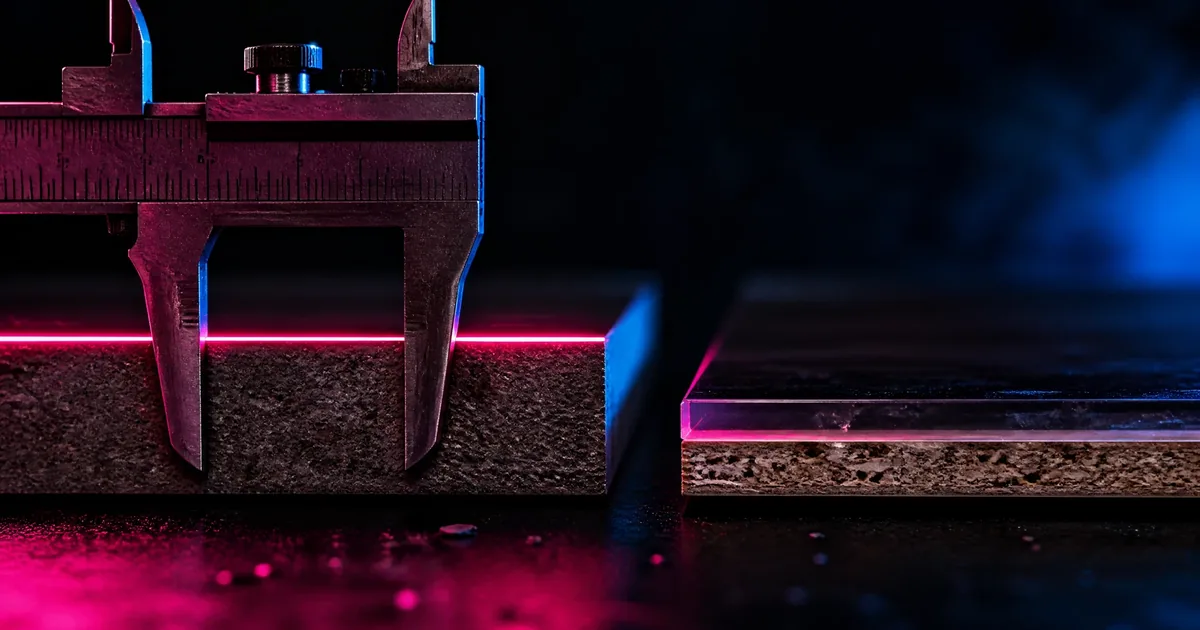
Twelve millimeters is more than eight millimeters. That is arithmetic, and it is correct. It is also not the number that decides whether your floor scratches, dents, or survives a dropped pan.
Where this one comes from
The millimeter figure is printed biggest on the box because it is the easiest thing to compare. Shoppers pick up two samples, feel the weight, and choose the heavier one. Salespeople know this and lead with it, because 12 mm sounds like a score and 8 mm sounds like a warning.
Thickness is real. It just is not the durability score it looks like. A plank is a stack of layers, and the number on the front of the box describes the whole stack, not the part you walk on.
Two numbers doing two different jobs
Plank thickness is the entire board, top to bottom, measured in millimeters. On vinyl, the wear layer is the clear top coat measured in mils, which are thousandths of an inch. Those are different measurements of different things, and mixing them up is the most common mistake in the aisle.
The wear layer is the part that takes grit, chair legs, and the dog. A 12 mm plank with a thin wear layer will wear through before an 8 mm plank with a thick one. The millimeter number tells you how much floor there is. The mil number tells you how long the surface lasts.
What thickness actually buys
- Feel. A thicker SPC or WPC plank feels and sounds more solid underfoot, less like walking across a drum.
- Tolerance. A thicker board bridges minor subfloor variation better than a thin one, which matters in older houses.
- Quiet. More mass, plus a thicker attached pad, can reduce sound transmission to the room below.
- On laminate, mostly sound. A thicker laminate sounds less hollow. It does not resist water or wear any better.
What it does not buy: scratch resistance, dent resistance, or a pass on subfloor prep. Core density and the locking system decide how a plank holds up over time. A thick plank over a hump, a dip, or a damp slab still fails, and it usually fails at the joint first, which is the one place thickness was supposed to help.
One more trap: the sample on the showroom rack is a cut-down display piece, and display pieces get handled by everyone who walks in. It tells you how the board feels in your hand. It tells you nothing about the wear layer, because you cannot see it, and nothing about how the joint will behave in a long run with a hallway turn in the middle.
How to read the spec sheet instead
Ask for four things, in this order.
- The wear layer in mils, or the AC rating on laminate. The AC scale runs from AC1 to AC5, and higher numbers are rated for heavier traffic.
- The core. SPC, WPC, or HDF, and whether that core is rated for the moisture the room will see.
- The joint. A locking system that clicks tight and stays tight is worth more than two extra millimeters of board.
- The warranty, in writing, including what voids it. Most manufacturers specify a flatness tolerance for the subfloor, and no plank is thick enough to ignore it.
If the label uses a word you cannot define, look it up in the glossary of flooring terms. The wear layer explainer goes deeper on the mil number specifically, and the material matchup compares constructions instead of millimeters.
The short version
- Thickness is the whole board in millimeters. Wear layer is the top coat in mils.
- A thick plank with a thin wear layer still wears through.
- Thickness buys a solid feel, better bridging of small subfloor variation, and less noise.
- Core density and the locking system decide durability, not the millimeter number.
- A thick plank over a bad subfloor still fails, usually at the joint.
- Check wear layer or AC rating, core, joint, and warranty before you check thickness.
Quick answers
Is a thicker vinyl plank more durable?
Not by itself. Thickness changes how solid the floor feels and how well it bridges minor subfloor variation. Wear resistance comes from the wear layer in mils, and strength comes from the core and the locking system.
What is the difference between plank thickness and wear layer?
Thickness is the whole board measured in millimeters. The wear layer is the clear top surface measured in mils, and it is the part that takes foot traffic, grit, and chair legs.
Is thicker laminate better than thinner laminate?
Thicker laminate sounds less hollow and feels more solid underfoot. It does not resist water or wear any better, so check the AC rating and the core rather than the millimeter number alone.
Will a thick plank fix an uneven subfloor?
No. A thicker board bridges small variation better, but most manufacturers still specify a flatness tolerance. Past that tolerance the joint takes the stress, and the floor fails there.