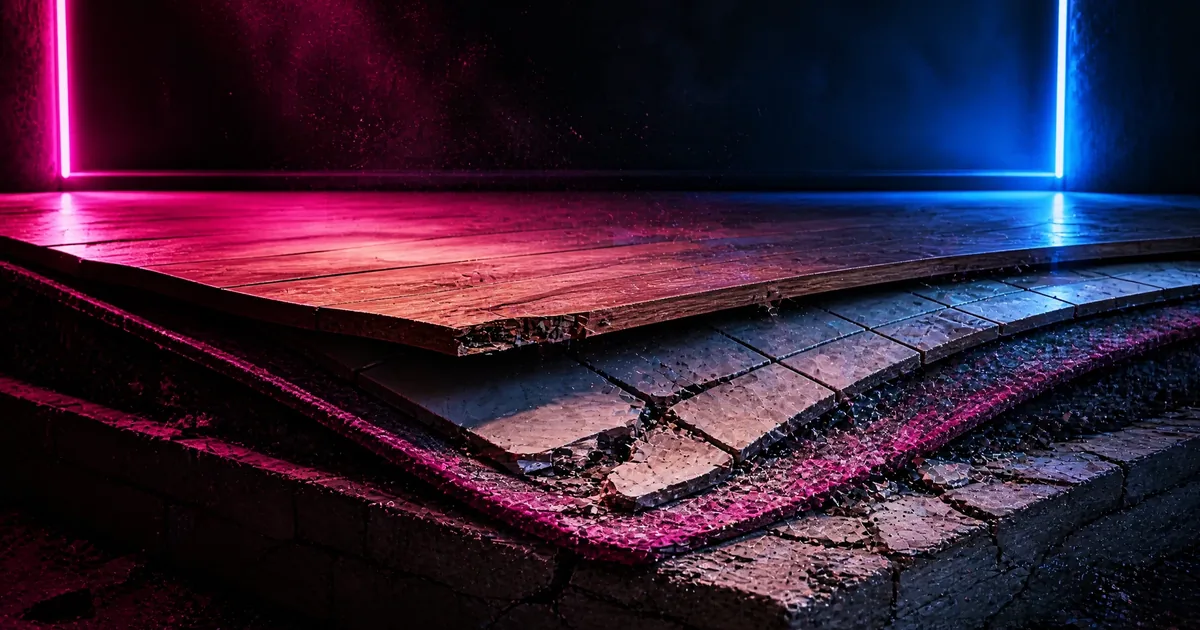


Tile is stone. Stone does not break, except when it does, and then the tile is usually innocent. Most cracks start underneath it, in whatever is holding it up.
Where this one comes from
Tile sells itself as permanent. It is hard, it is old, it does not care about your dog. Porcelain tile in a showroom, over a perfectly built display floor, feels like a promise that nothing bad will ever happen to it again.
The promise is half true. Tile is genuinely hard and genuinely durable on the surface. It is also brittle, which means it does not bend. When the floor under it moves, the tile does not flex with it. It cracks. That is not a manufacturing failure. It is physics doing its job.
What actually breaks a tile
Deflection is the big one. A floor framed for carpet was built to a certain stiffness, and the tile industry asks for more than that. If the joists flex under a load, the tile above them flexes a fraction of an inch, and porcelain does not do fractions. A floor that feels fine underfoot can still be too springy for tile.
Hollow thinset is next. If the installer spot-bonded the tile instead of covering the back, there are voids under it. Step there, drop something there, and the tile spans the void like a bridge with no support. Tap across a floor with a coin or a screwdriver handle and listen: a dull thud is bonded, a hollow ring is a future crack.
Missing movement joints cause slow, wide cracks. Tile expands and contracts with heat and moisture. The perimeter and large fields are supposed to have joints that let it move. Skip them because they look like a detail, and the movement shows up in the tile instead.
Then there is plain impact. A cast-iron pan, a ladder leg, a heavy point load on a small area. And thermal movement, which is worse in a sunroom or over a heated floor, where the surface swings more than the structure does.
The tile itself still matters, just less than the floor under it. Porcelain is fired hotter and denser, with lower water absorption and more strength. Ceramic has a softer body and a glaze, and it chips and cracks more readily. Natural stone varies piece to piece, with fillers, veins, and bedding planes that decide where it splits.
Porcelain being stronger does not make it flexible. It is the best of the three for a floor that moves a little, and it still cracks over a hollow spot. Our material matchup compares them on the specs that matter, and the explained glossary covers the ratings printed on the box.
Large format makes all of this worse
A big tile is a bigger lever. Any tiny bit of flex at one edge transfers across the whole piece. That is why large-format tile wants a flat substrate, not just a structurally sound one, and full coverage under the entire tile rather than five dabs and a prayer.
A wavy floor plus spot-bonded thinset plus a 24 by 48 inch tile is the most reliable crack recipe in the trade. The tile is not the problem. The bed under it is.
What to do instead
Fix the floor, not just the tile. If deflection is the cause, stiffen the framing or add plywood before anything gets glued down. If the substrate is out of flat, flatten it. If the old thinset left voids, remove the loose tile, grind or fill, and set the new one with full coverage.
Put movement joints where the standards call for them, at the perimeter and across large fields, and do not let anyone talk you out of them because they interrupt the pattern. Keep a box of spares from the same run for future repairs, because dye lots change.
Before you fall for a sample, ask how it will be set: what substrate, what coverage, what joints. There is more on choosing a floor that suits the room in our materials section, and it is worth reading before you commit.
The short version
- Tile is hard and brittle. It does not flex, so the floor under it has to.
- Most cracks come from deflection, hollow thinset, or missing movement joints.
- Tap the floor. A hollow ring means the tile is not bonded and is waiting to break.
- Large-format tile needs a flat substrate and full coverage, not spot bonding.
- Movement joints at the perimeter and across big fields are structural, not decorative.
- Replace the cause, or the new tile cracks in the same place.
Quick answers
Does a cracked tile mean the tile was defective?
Usually not. Most cracks come from movement, deflection, or a thinset bed with voids under the tile. A defect is possible, but it is the least likely explanation and the least useful one to lead with.
Can I just replace the cracked tile?
You can, and it will crack again if the substrate or the installation method caused the first one. The fix usually involves stiffening or flattening the floor, achieving full thinset coverage, and adding movement joints where they were skipped.
Why do large tiles crack more easily?
Large-format tile needs a flatter substrate and full coverage under the whole tile. A wavy floor and spot-bonded thinset leave hollow areas, and the tile flexes over them until it breaks.
Are expansion joints really necessary?
Yes. Tile moves with temperature and moisture, and movement joints at the perimeter and across large fields give that movement somewhere to go. Without them, the stress goes into the tile.