
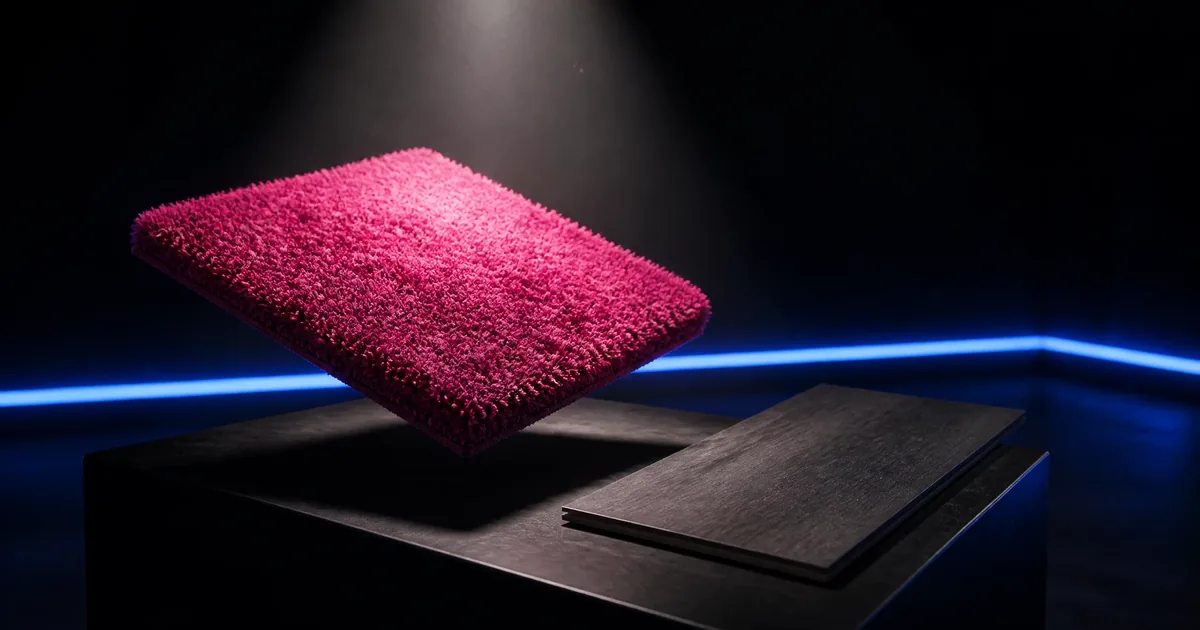
Carpet did lose the open-plan living room, the kitchen, and most of the photos on the internet. It still has the stairs, the bedrooms, and the basement, and it is not going anywhere. “Carpet is dead” is a design preference wearing a lab coat.
Where this one comes from
Walk through a new build or scroll a renovation feed and you will see the same floor everywhere: wide plank, gray-brown, hard as a parking lot. Hard flooring got cheaper, more water-resistant, and much easier to photograph. Vinyl and laminate caught up on looks, so the main floor went hard, and the design world declared a winner.
Some of that shift is real. Hard floors are easier to clean, they handle pets and spills, and they do not trap a smell the way a pad can. None of that makes carpet obsolete. It makes carpet a room-by-room decision instead of a whole-house default, which is what it should have been all along.
What carpet is actually good at
Warmth is the obvious one. A bedroom carpet is warm at six in the morning in a way that no area rug fully fixes. Quiet is the second: carpet absorbs impact noise and footfall, which is why upstairs bedrooms and stairs are still carpeted in houses where everything else is hard.
Soft matters more than people admit. Kids fall on it. Aging knees prefer it. A stair with carpet has fewer hard edges to land on and more traction under a sock, which is why so many people who plan to stay in their house keep it there.
Then there is speed and cost. Carpet goes down fast, it can be replaced room by room, and in a rental it is the forgiving choice when a tenant’s deposit is already a negotiation. None of that is nostalgia. It is the same reason offices use carpet tile: it works.
The trade-offs are specific, not categorical
Moisture is the one that actually matters. Carpet in a bathroom is a bad idea. Carpet on a damp basement slab is a bad idea, and no amount of padding fixes a slab that is pushing vapor. Test the concrete, fix the drainage, then decide.
Allergens are more nuanced than the internet allows. Carpet holds dust, and how much it holds and releases depends on the fiber, the backing, the pad, the ventilation, and how often it gets vacuumed and cleaned. A well-maintained carpet in a dry room is not the same product experience as a matted, damp one that has not been cleaned since it was installed.
Staining and wear depend on the fiber and the pile. A low-pile, solution-dyed carpet in a hallway behaves nothing like a soft white plush in a mudroom. Blame the spec, not the category. And yes, new carpet has a smell for a few days. So does new hardwood finish. Ventilate the room and let it cure.
The other side of the trade is real too. Hard floors are easier to clean, and that is not nothing. They are also harder, louder, and colder. Drop a glass on tile and you get a project. Drop it on carpet and you get a glass. A hard floor needs a flat substrate, and a bad one shows every hump. Pet nails click. Standing water on a wood floor is a phone call to a contractor.
A house with hard floors everywhere is a house with echo, cold feet, and a lot of rugs pretending to be carpet. A house with carpet everywhere is a house with a damp basement problem waiting to be discovered.
What to do instead
Choose by room and by use. Carpet in bedrooms, on stairs, and in a finished basement that is actually dry. Hard floor in kitchens, bathrooms, entries, and anywhere a mop is the correct tool. If stains are the worry, ask for a low-pile, solution-dyed product and a good pad. If moisture is the worry, solve the moisture first.
Then read the spec sheet like you would for any other floor, because carpet has one too: fiber, backing, pile, and the warranty terms for wet areas. The material matchup compares it with the hard surfaces, and the materials section has the long version. If you are layering floors rather than replacing them, read what happens when you go over an old floor first, because carpet is the one surface you cannot float over.
The short version
- Carpet lost the main floor, not the whole house. Bedrooms, stairs, and dry basements still belong to it.
- Warm, quiet, soft, and fast to install are real advantages, not nostalgia.
- Moisture is the actual problem. Carpet in a bathroom or a damp basement is a mistake.
- Allergen performance depends on fiber, backing, pad, ventilation, and cleaning, not on the word “carpet.”
- Hard floors are easier to clean and harder, louder, and colder. That is the trade.
- Pick per room, and read the carpet spec sheet the same way you read a plank spec sheet.
Quick answers
Is carpet still a good choice for bedrooms?
Yes. It is warm underfoot, quiet, soft for kids and older knees, and fast to install. It is a poor choice in a bathroom or a damp basement, where moisture has nowhere good to go.
Does carpet make allergies worse?
It can hold dust, but the outcome depends on fiber, backing, pad, ventilation, and how often you vacuum and clean. Carpet that is kept dry and cleaned on schedule is a different situation from carpet in a damp room.
Why do offices still use carpet tile?
Acoustics and replacement. Carpet absorbs sound in a way hard floors do not, and a stained or worn tile can be swapped without ripping up the whole floor.
Is hard flooring easier to maintain than carpet?
It is easier to sweep, mop, and spot clean. It is also harder, louder, and colder, and dropped glass does not survive it. Maintenance is a trade, not a free win.