
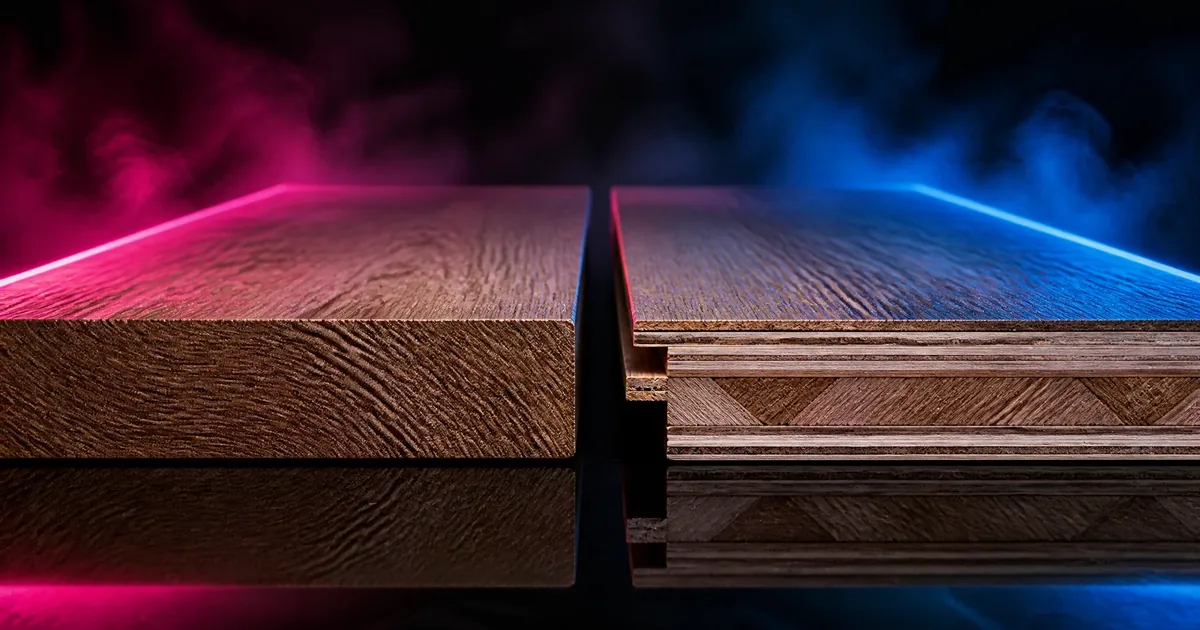
Solid hardwood is one piece of wood, three quarters of an inch thick, nailed down and sanded for decades. Engineered hardwood is a real wood top glued to a stable core. Neither one is fake, and the label on the box is not what decides whether your floor survives.
What each one actually is
Solid hardwood
One species, one piece, milled with a tongue and a groove. The standard thickness is 3/4 inch, and that thickness is the whole point: it is reserve material. A solid floor can be sanded and refinished several times over its life, which is how a hundred-year-old floor in an old house is still a hundred-year-old floor instead of a memory. Every refinish takes a little off the top, and the board is deep enough to give it.
Solid hardwood goes down over a wood subfloor, meaning plywood or OSB over joists, and it gets nailed or stapled through the tongue. It cannot be glued to concrete in any ordinary residential job, and it cannot float. Those are not installer preferences. They are what the material does.
It also moves. Wood takes on moisture in humid weather and gives it up in dry weather, so a solid floor swells in summer and shrinks in winter. That movement is why the boards are narrow, why the installer leaves a gap at every wall, and why you cannot just drop a solid floor into a basement. Below grade and on-grade concrete are hard on solid wood, and the usual fix is a subfloor system: sleepers, a vapor barrier, and a plywood deck, which raises the floor height and the budget at the same time.
Acclimation is part of this. Boards sit in the room, in the boxes, long enough to reach the moisture content of the space they will live in. Skip that and you install a floor that is already the wrong size. If you want the short version of that argument, it is in does flooring need to acclimate, and it applies to both products here, not just the solid one.
Engineered hardwood
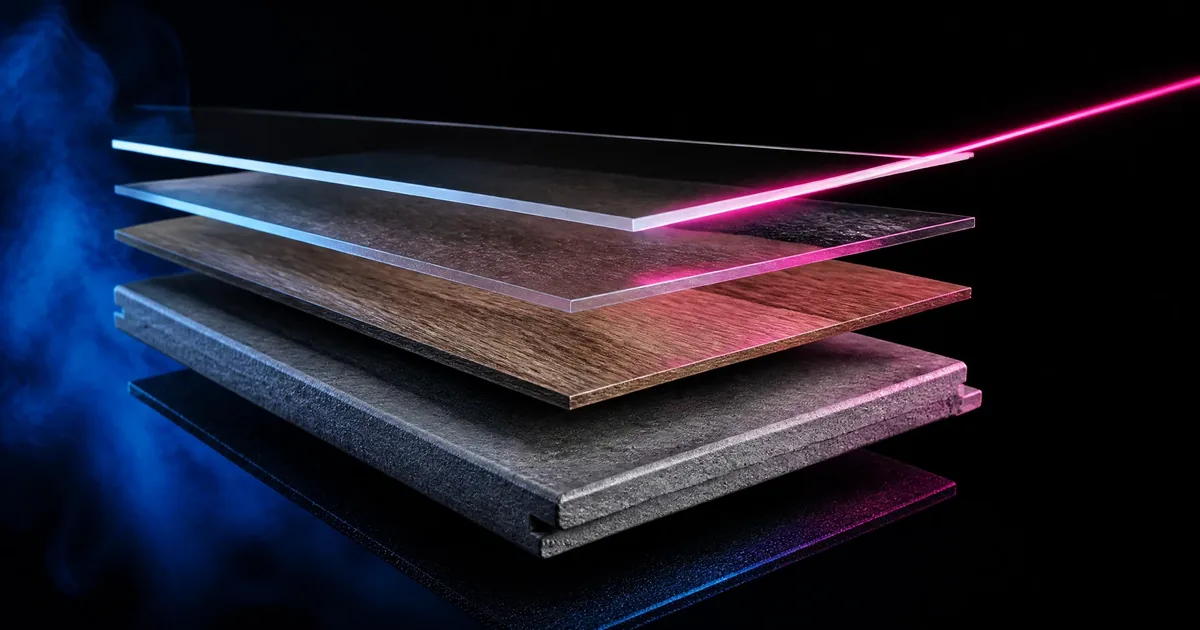
A wear layer of real wood, glued to a core. The core is usually plywood, sometimes HDF, and the plies run in alternating directions. That cross-grain construction is the entire engineering trick: it resists the seasonal swelling and shrinking that a single piece of wood cannot.
The wear layer is real wood. Not a picture, not a laminate printed to look like oak. It is a slice of the species named on the box, usually somewhere around 2 to 6 millimeters thick, and that range is deliberately wide because the market is deliberately wide. A good engineered plank has enough wood on top to be sanded once or twice. A cheap one has a veneer thin enough that a heavy-handed sander goes through it and into the core, at which point you own a floor with a bald spot.
Because the core is stable, engineered can be installed in ways solid cannot. Depending on the product, it can float over an underlayment, glue down to a slab, or staple to a wood subfloor. Many engineered products are rated for concrete and for radiant heat, if the manufacturer says so in writing. That flexibility is the reason engineered exists, and it is a real advantage rather than a marketing story.
Engineered does not mean fake. It does not mean inferior by default. It means assembled, and the quality of the assembly is what you are actually buying.
Refinishing, wear layers, and the numbers that matter
Here is the part where the two categories stop being categories and become individual products.
Refinishing capacity comes down to how much wood sits above the core. A solid 3/4 inch board has roughly three quarters of an inch of sandable material, so it can take several sandings across its life. An engineered plank with 6 millimeters of wear layer can usually be sanded once or twice. An engineered plank with a veneer measured in fractions of a millimeter may not be sandable at all, and no amount of sales confidence changes that. Ask for the wear layer thickness in millimeters and get it in writing. If the answer is a shrug, that is also an answer.
The finish on top is a separate spec. Factory finishes are cured hard and are usually tougher than anything applied on site, and the texture matters too: smooth, wire-brushed, hand-scraped, and saw-marked all behave differently under a mop and a dog. Our plain-English glossary covers how finish and wear layer get described, and the materials matchup puts the categories side by side if you want to see where engineered lands against laminate and vinyl.
Price is not a reliable proxy for any of this. A cheap engineered floor with a thick veneer can outlast an expensive one with a veneer you could read a newspaper through. The number on the tag tracks the brand, the finish, the width, and the showroom, in roughly that order, and it does not track the thickness of the wood on top unless you check.
Movement, moisture, and where each one can live
Wide planks and long boards move more. A seven-inch plank expands and contracts across more wood than a three-inch plank, so it shows gaps and peaks sooner when the humidity swings. A long board also accumulates more total movement end to end, which is why very long boards want more room at the perimeter and a more careful layout. This is true for solid and engineered alike. The core buys you stability, not immunity.
Neither one is waterproof. Not the solid, not the engineered, not the one with the impressive finish and the waterproof-sounding name on the display. Water on hardwood is a stain, a cup, a crown, or a seam that opens, and the fix is a towel and a fan rather than a warranty claim. If the room is a bathroom with a tub, a laundry room with a known leak, or a basement that gets damp, you are shopping in the wrong category and the materials matchup will point you somewhere more sensible.
Basements and slabs are where the two products genuinely part ways. Solid over on-grade concrete needs a subfloor system, full stop. Engineered can go down over a properly prepped slab with the right adhesive or underlayment, which is why it is the usual answer for a finished basement that wants real wood underfoot. Radiant heat is similar: engineered often works, solid is a harder sell, and in both cases the manufacturer’s instructions outrank anybody’s opinion, including mine.
And no, the hardwood label is not a guaranteed bump in resale value. That argument gets made in every showroom and it is not as automatic as it sounds, which is why we wrote about it separately in hardwood always adds value. Buy the floor you want to live on, not the one you plan to flip.
What actually decides the outcome
Installation method, subfloor flatness, and moisture testing. In that order, and all three of them outrank the marketing category.
The install method has to match the product and the substrate. Nail or staple for solid over wood. Float, glue, or staple for engineered, depending on what the specific product allows. Glue-down over concrete is a different skill and a different adhesive than a float, and a crew that does one kind of install all day is not automatically good at the other.
Flatness is not a suggestion. Manufacturers print a tolerance, often something in the neighborhood of 3/16 inch over 10 feet, and a floor laid over a hump will show it, telegraph it, or come apart at the joint. Check it with a straightedge before anything gets opened.
Moisture testing is the step that gets skipped when the schedule gets tight. A wood subfloor gets metered. A concrete slab gets tested the way the adhesive or flooring manufacturer specifies, which is usually a probe or a vapor test rather than a plastic sheet taped down for a day. If the numbers are wrong, the floor fails later, and later is always more expensive.
Acclimation, expansion gaps, and humidity control finish the list. Keep the house at a steady, moderate humidity, which is also what your sinuses want, and the floor stops moving enough to notice. Skip it and the widest boards in the room will tell you about it in February.
None of this is a reason to pick one category over the other. A well-installed engineered floor beats a badly installed solid floor every day of the week, and the reverse is also true. The category tells you what the plank is. The installation tells you whether you got a floor.
The short version
- Solid is one piece of wood, usually 3/4 inch, nailed over a wood subfloor, and sandable several times over its life.
- Engineered is a real wood wear layer on a plywood or HDF core. More stable, more install options, often fine over concrete and radiant heat.
- Refinishing depends on wear layer thickness, roughly 2 to 6 millimeters on engineered and wildly variable. Ask in writing.
- Neither is waterproof. Wide planks and long boards move more in both categories.
- Installation method, subfloor flatness, and moisture testing decide the outcome far more than the word on the box.
- Price is not a quality signal. A thick veneer on a cheap plank outlasts a thin one with a fancy name.