
They sit on the same rack, both printed to look like white oak, both clicking together, both carrying a sticker that says waterproof. They are not the same floor. Laminate is pressed wood fiber with a photograph on top; vinyl is plastic all the way down, and that one difference decides almost everything else.
The stack, from the top down
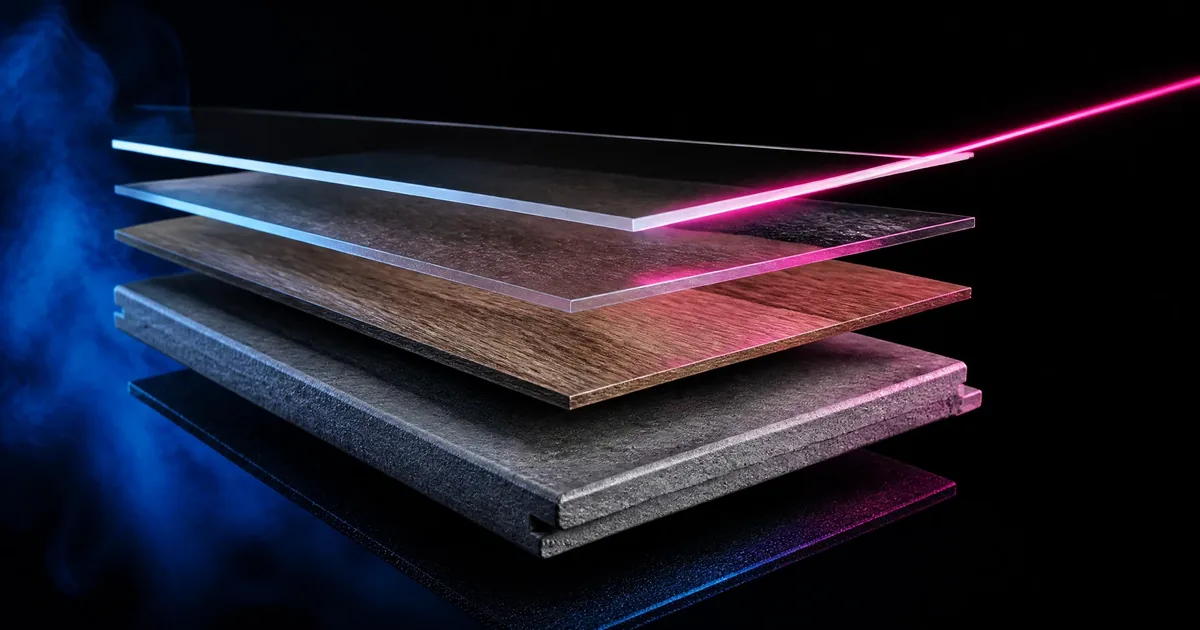
Flip a laminate plank over and you are looking at a sandwich made of paper, resin, and sawdust under pressure. The bottom is a backing layer that balances the panel. The middle is HDF, high-density fiberboard, which is wood fiber pressed with resin into a dense board. Above that sits the decor layer, a printed photograph of wood grain, stone, or tile. The top is the wear surface, a melamine-impregnated overlay cured hard, often with aluminum oxide in it. Most laminate is click-locked and floats over the subfloor with no glue and no fasteners.
Vinyl starts with PVC instead of wood fiber. Luxury vinyl plank is the family name, and the two cores you will meet are SPC and WPC. SPC is stone-plastic composite, PVC mixed with limestone, rigid and thin and happy to click together. WPC is wood-plastic composite, a foamed PVC core that is thicker, softer, and warmer underfoot. Both carry a printed decor layer under a clear vinyl wear layer. The core is plastic, so water does not swell it.
Formats differ too. Laminate is essentially always a floating floor. Vinyl can be glued down as a thin flexible plank, floated as a rigid click product, or in some lines laid loose on a prepared subfloor. That flexibility is one of vinyl’s real advantages, and it is also why two vinyl products with the same photo on the box can behave completely differently.
Wood fiber versus plastic. Every other difference in this article grows out of that one.
Thickness is not a scoreboard
A salesperson will reach for the millimeter count because it is the one number you can check with your thumb. It is also the least useful number in the comparison.
Laminate commonly comes in 8, 10, and 12 millimeters. A thicker board mostly buys a taller click profile and a bit more heft underfoot. It does not buy a longer life. That comes from the wear surface, the core density, and how well the subfloor was prepped. A 12mm plank with a thin overlay is not a better floor than an 8mm plank with a good one.
Vinyl runs thinner, often 4 to 6 millimeters with an attached pad, and the number that matters is the wear layer in mils. Most residential vinyl lands between 6 and 12 mils; heavier traffic and commercial products go above that. Our wear layer explainer covers how that number is measured and what it does not tell you.
Laminate is rated differently, by AC class. AC1 through AC5 is a wear rating built on abrasion, impact, and stain tests. AC3 is the usual residential rating, with AC4 and AC5 sold for heavier traffic. It is a real rating with a real test behind it, and it says more about the floor’s surface than the thickness does.
Sound is the other place thickness lies. Laminate is usually thicker and sounds hollower, a hard click that carries across a room. Vinyl is often thinner and quieter, especially with a pad attached. If someone in the house works nights, or the floor sits above a bedroom, that difference is worth more than two millimeters.
Water, sunlight, and heavy things
Water decides most of these arguments. Laminate’s HDF core is the weak point: water that reaches it swells the fiber, mushrooms the edges, lifts the seams, and does not shrink back when it dries. Waterproof-rated laminate seals the core and the joint, usually with a treated edge and a tight click, so a spilled glass that gets wiped up is a non-event. Standing water is not. Read why laminate and water are not friends before you put laminate in a bathroom and hope for the best.
Vinyl’s core is waterproof, full stop. A puddle on an SPC plank does not swell it, which is why bathrooms, laundry rooms, and basements keep ending up with vinyl in them. The catch is that waterproof describes the plank, not the floor assembly. Water still runs down the perimeter gap, under the floor, and sits on the subfloor. Over concrete, that vapor question gets answered with a barrier, not a label.
Sunlight is friendlier to laminate than people expect. The decor layer is buried under a cured overlay, so the print does not fade the way an exposed printed surface would. Vinyl holds up too, but dark vinyl in a hot sunroom gets soft and starts telegraphing every imperfection in the slab. Neither floor enjoys a window that bakes it all afternoon.
Heavy things are vinyl’s weak spot. SPC can dent or crack under a concentrated point load: a piano leg, a cast-iron stove, the corner of a loaded refrigerator, a chair with a narrow metal foot. Laminate is harder at the surface and takes point loads better, but it chips at the seam if the subfloor is not flat, and it does not enjoy being dragged across.
Repair, replacement, and which room gets which
Repair is where the two materials stop being a coin flip and start being a commitment.
What happens when a plank dies
Laminate is usually floating, which means it is at least theoretically serviceable. A damaged plank in the middle of a floating floor can sometimes be cut out and replaced with a new plank that has its locking tongue removed and its edges glued. It is a real repair, done by someone who has done it before, and the patch can show in raking light. At the end of a run it is easier: pull the baseboard, unclick back to the bad plank, swap it, and relay.
Glued vinyl cannot be swapped. It is adhered to the subfloor, so the only repair is to cut out the damaged area and patch it, and the patch will show unless you have leftover material from the same run and a steady hand. Floating SPC is more forgiving, but only from the edge of the room. A plank in the middle of a glued-down floor is a permanent resident.
Neither floor can be sanded and refinished. Laminate’s wear surface is cured resin, not a layer of wood; vinyl is vinyl. What you buy is what you keep, which is another reason the wear rating and the warranty matter more than the color on the sample.
What belongs where
Start with the room, not the sample. A bathroom, laundry room, mudroom, or basement wants vinyl, because the failure mode in those rooms is water and vinyl’s core does not care. A living room, hallway, or bedroom on a stable subfloor with normal humidity can take either, and then it comes down to feel, sound, sunlight, and what the spec sheet says.
Then check the subfloor. Both are floating-friendly, and neither forgives a hump or a dip. Vinyl is thinner and telegraphs imperfections sooner; laminate bridges minor variation better but can sound hollow and rock at a seam. If the slab is flat and dry, either works. If it is not, the floor is not the problem to solve first.
Read the spec sheet like it owes you money. For laminate, that means the AC class and the warranty language about moisture. For vinyl, the wear layer in mils, the core type, and whether the product is rated for the room you have in mind. The material matchup hub keeps these comparisons in one place, and the explained section handles the vocabulary.
Ignore the packaging. Waterproof on a laminate box means the core is sealed, not that the room is. Commercial grade on a vinyl box means somebody in marketing liked the phrase. The spec sheet is boring, and it is the only part of the purchase that will still be true in five years.
The short version
- Laminate is an HDF core with a printed photo and a hard melamine wear surface. Vinyl is a PVC core with a printed photo and a clear vinyl wear layer. Different materials, different failure modes.
- Water is the deciding vote. Laminate swells when water reaches the core, even the waterproof-rated kind; vinyl’s core does not.
- Ignore plank thickness. Check the AC class on laminate and the wear layer in mils on vinyl.
- Laminate feels harder and louder. Vinyl feels warmer and quieter, especially with an attached pad.
- A floating laminate plank can sometimes be swapped. Glued vinyl cannot.
- Pick by room, subfloor, moisture, and the spec sheet. Neither floor is automatically cheaper or better.