
The plank is waterproof. That part is true, and it is the entire claim. The room is a different story, and the room is the one you actually live in.
What the label actually covers
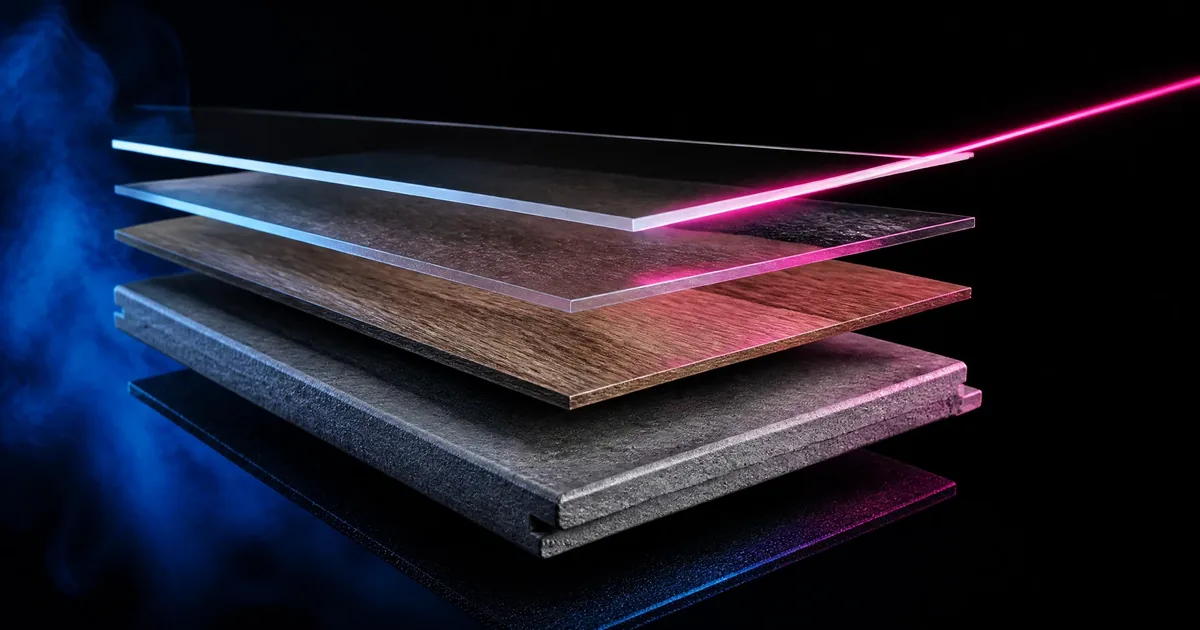
Rigid-core vinyl, which is what SPC and WPC mean at the end of the product name, is a core of PVC mixed with limestone. Plastic and stone do not swell. Soak a plank overnight and it comes back the same shape it went in. Most of these products pair that core with a click joint engineered to keep a spill out of the locking channel. That is a real, tested property, and it is why the box can say waterproof without technically lying.
Read the sentence again. The plank is waterproof. Not the floor. Not the room. Not the subfloor.
“Waterproof” is a property of an object. Your floor is an assembly: planks, joints, gaps, trim, underlayment, subfloor, and whatever is under the subfloor. The box describes one part of that assembly, and it describes it accurately. The trouble starts when the word gets applied to the whole thing. We take the long version apart in waterproof flooring means the room is waterproof, but the short version is this: nothing in the assembly except the plank was promised anything.
There is also a number on that label that has nothing to do with water: the clear top coat. If you have wondered why two planks with the same picture cost different amounts, what a wear layer is explains it. That is a durability spec, not a waterproofing one.
Water-resistant and waterproof are not synonyms, even though the aisle treats them that way. One means the material holds up for a while. The other means nothing gets through. Guess which one sells better.
What the other categories claim
Wood is not waterproof. Solid and engineered hardwood both move with humidity, and both will cup, crown, or stain if water sits on them. A polyurethane finish buys you time to find a towel, not a free pass.
Most laminate is water-resistant at best. Waterproof laminate usually means the manufacturer sealed the core and treated the joint, which genuinely helps with spills and genuinely does not mean you can leave water on it. An edge is all laminate needs.
Tile is waterproof. The tile is. Grout is not, and neither is the thinset holding it down. What makes a tiled floor waterproof is the membrane underneath, and skip the membrane and your beautiful tile floor becomes a very expensive way to water your subfloor.
Where the water still gets in
Four places, roughly in order of how often they cause a callback.
The seams. A click joint is a mechanical lock, not a gasket. It handles a spill you wipe up and a splash from the dog bowl. It does not handle a quarter inch of water sitting on it for an afternoon, and it does not handle a joint that was never fully engaged or that has grit in the channel. Installers call those open joints, and they leak exactly the way you would expect.
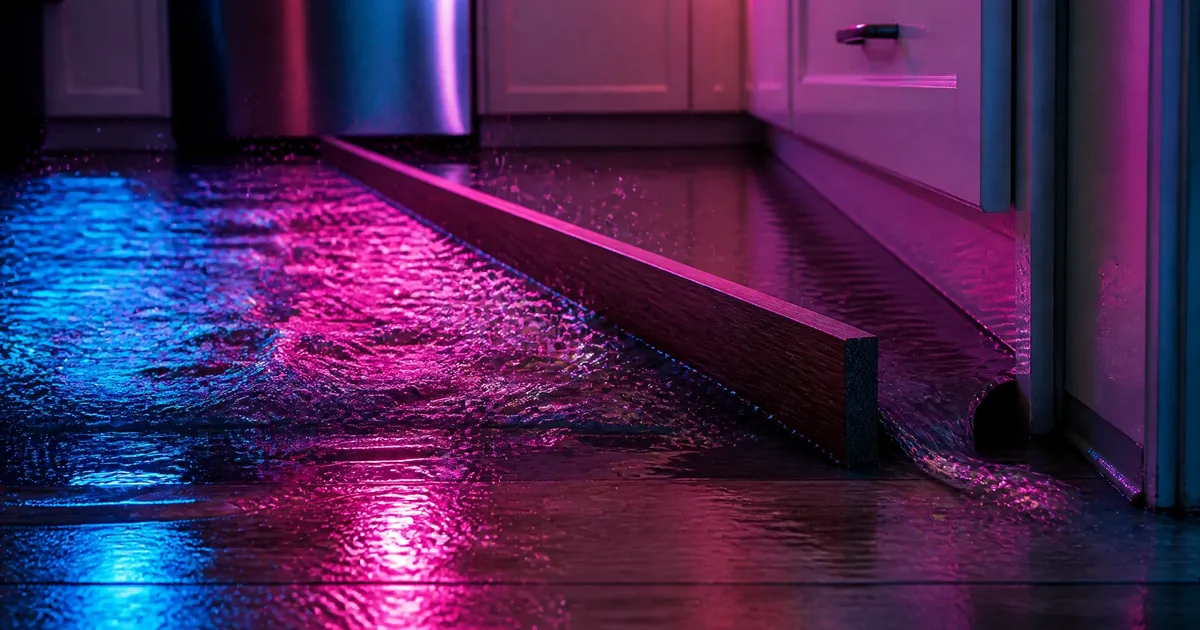
The perimeter gap. Every floating floor needs a gap at the wall so the planks can expand. That gap is by design, and it lives under the baseboard where you cannot see it. Water that runs to the wall, from a mop bucket, a leaking supply line, a tub overflow, or a kid with a hose, runs into that gap and lands on the subfloor. Under the floor. Where you cannot see it and cannot dry it. The plank survives. The subfloor does not always.
Penetrations. The toilet flange, the vanity legs, the door threshold, the floor vent. Every hole cut through a floor is a place where water can pass through a floor. The plank is waterproof right up to the hole and no further.
From below. Concrete gives off vapor. That is what concrete does, and a waterproof plank on a slab does nothing about moisture coming up from underneath. Waterproof cuts both ways: the barrier that keeps water out of the plank also keeps vapor from getting out of the slab. Over concrete you want a vapor barrier or a rated underlayment, whether or not the box says waterproof in large letters.
There is a fifth one that gets skipped, which is the attached pad. Some rigid-core products come with foam glued to the bottom. That foam holds water against the subfloor long after the surface looks dry, and then it smells.
Standing water, flooding, and wet rooms
These are three different problems, and the label answers none of them.
A spill is a wipe-up. A spill has an end. Get to it with a towel and the plank, the seam, and probably the subfloor are all fine.
Standing water is a clock. Water on a seam for a minute is a spill. Water on a seam overnight is a small flood, whatever you call it. It wicks into the gap, it sits under the planks, and it goes looking for the lowest point in the assembly, which is never where you are standing. This is also what a pet accident turns into if it sits.
Actual flooding is a demolition question. If a supply line lets go while you are at work, the flooring is not the expensive part. The subfloor, the drywall, and everything below are. Warranties on waterproof floors typically exclude flooding, standing water, and damage to the subfloor, and the exclusion is written plainly in a section nobody reads. Read yours before you need it.
A wet room is a category again. A bathroom with a tub or shower and no floor drain is a room where water lands on the floor regularly and has nowhere to go. A true wet room, meaning tile, a floor drain, and a slope running to it, needs a waterproofing membrane under the tile, tied into the drain flange, plus the right backer board and sealant. The membrane is what makes that room waterproof. The tile is what makes it look like a bathroom. Lay a waterproof plank in a wet room and skip the membrane, and you have a decorative layer on an unprotected subfloor.
None of that means vinyl is wrong for a bathroom. It means vinyl is not a substitute for waterproofing. A half bath with a toilet and a sink is a reasonable place for rigid-core vinyl, as long as you wipe up and you are honest with yourself about the tub.
What to do about it
Wipe spills when they happen. That is the whole strategy for a normal room, and it costs nothing.
Over concrete, put down a moisture barrier or a rated underlayment, and ask what the product is rated for rather than whether it is waterproof. The materials matchup covers which categories need that barrier, and the plain-English glossary covers the vocabulary you will hear while you ask.
At the perimeter, close the gap where it makes sense. A bead of sealant where the floor meets a tub, a shower curb, or a vanity is cheap insurance. Do not pump a tube of caulk into the expansion gap along a long wall. That gap is there so the floor can move, and filling it solid trades a water problem for a buckling problem.
In a bathroom with a tub or a shower, do not let the plank label talk you out of a proper waterproofing detail. Use a membrane under tile, or use a formed shower base and a floor that can take a splash and be dried. If the room has a drain in the floor, it is a wet room and it needs wet-room construction.
Keep the receipt, the spec sheet, and the installation instructions. If you ever file a claim, the argument that wins is not that the box said waterproof. It is that you installed it per the manufacturer’s instructions, over a rated barrier, with the gap the instructions asked for.
The short version
- The waterproof claim covers the plank and, if the spec sheet says so, the joint. It does not cover the room, the gaps, or the subfloor.
- Water gets in at seams, perimeter gaps, penetrations, and from below as vapor. Those are installation details, not product failures.
- Over concrete, always use a moisture barrier or a rated underlayment, even under waterproof planks.
- Wipe up spills. Standing water and flooding are excluded by most warranties and hurt the subfloor more than the floor.
- In a bathroom with a tub or shower, waterproofing means a membrane or a formed base, not a label.
- Tile is not waterproof either. The membrane under it is what protects the assembly.